

They may use the format currently being used in the Champions League for the Euro qualifiers.
UEFA is planning a change to the qualification format for the European Championship. “There could be some changes to how the qualifying matches are played. There will be no more games but it will be more exciting. This is something we are looking at right now,” said UEFA President Aleksander Čeferin.
What Doesn’t Work in the Current Qualification Format and What the New One Might Look Like
According to The Times, UEFA will perform a full-scale audit of the qualifying matches system for the World and European championships, because both broadcasters and fans are showing less interest in the encounter. A special working group was established for this purpose. Its goal is to examine various formats for the qualification tournament system for World Cups and European Championships.
Among other things, the group will examine various systems. The possibilities include the use of the UEFA Nations League as a qualifier for major tournaments or the system currently in use for the Champions League. A meeting was held in Malaga, attended by 55 general secretaries of European federations. At this meeting they received information on potential changes and the advantages and disadvantages of the Nations League and Champions League models.

Alexander Ceferin presents Cristiano Ronaldo with the Nations League trophy – gettyimages.co.uk
“Revenue from broadcasting rights and fan engagement during qualifying matches are falling,” the newspaper states, referring to a source close to the matter. “However, in the Nations League both of these indicators are rising. The idea has been proposed before. It is extremely difficult to come up with a formula that will ensure a competitive environment for powerful national teams and provide a possibility for weaker teams to advance.”
As of 2023, UEFA has been conducting the women’s Nations League as a qualifying tournament for World Cups, Euros and the Olympics. The new working group will determine if the experience gained in the women’s version can be transferred to the men’s version. The main disadvantage of the system is the decrease in the number of matches involving middle tier teams against stronger opponents.
The other option is the format used for European cups. Here each of the 55 national teams would play 6 or 8 games against different opponents depending on seeding. An example of this is the England national team, which will play against Serbia, Albania, Latvia and Andorra in the 2026 World Cup qualifiers. Not a single of those games attracts broadcasters. The new format will allow the team to compete in 2 games against opponents who are roughly at the same level as England.
One table – as in the Champions League. If the new format were used for the current 2026 World Cup qualifiers, the top 12 teams could automatically move to the next round. And teams ranked from 13 to 20 could fight it out for additional spots in the playoffs. Nevertheless, there is a fundamental difference between club tournaments and national team tournaments. The format for the Champions League is not considered a “magic formula” for national team qualifying in the UEFA zone.

The new format has resulted in more top-level matches in the Champions League – mirror.co.uk
The English Journal Suggests Using the Champions League Model
In a Sunday Times column, the shortcomings of the current UEFA zone qualification process for European tournaments are described using the example of the England national team.
“England has ahead of it a game against a team that is over a hundred places below it in the FIFA rankings. On Tuesday, a game against Latvia. The only officially scheduled game during a two-week international break. How dull! England has lost only one qualifying match for a major tournament since October 2009. Back then, however, they lost to Ukraine in Dnipro. However, for England the loss meant absolutely nothing, because the team had already clinched first place in the group.
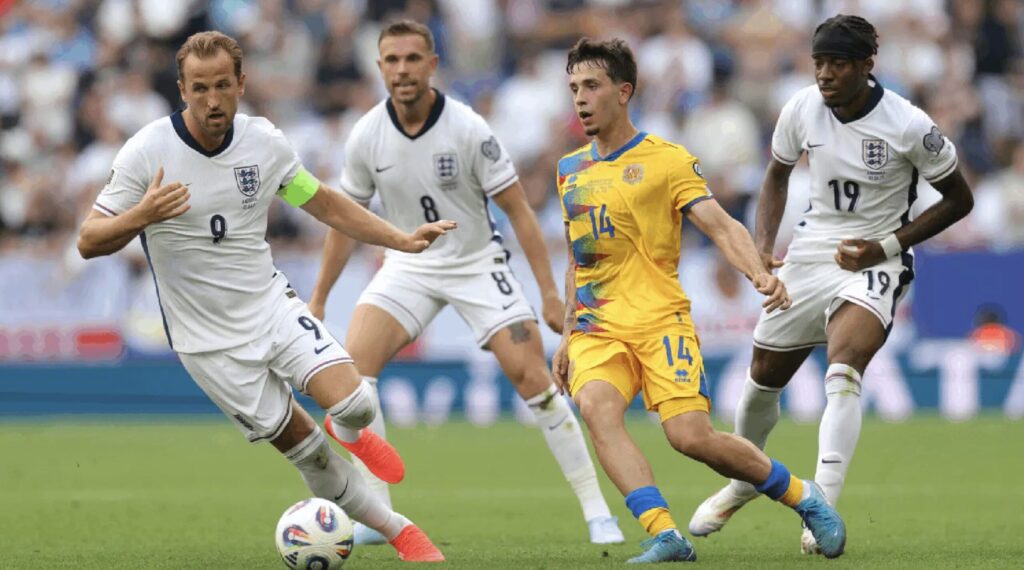
England vs. Andorra match in the 2026 World Cup qualifiers – supersport.com
The problem lies in the fact that there is too little risk for a national team to pass through the qualification process. 55 national teams; 24 of them go to the European Championship. 43.6%. That is a relatively high percentage. To prevent a national team from participating in the tournament, they really need to mess up badly. The road to the World Cup is more complicated but almost just as good. 16 teams will go to the tournament; 29% of the total number. The last time England did not participate in the tournament, UEFA allowed 12 national teams and Germany as the champion to the World Cup.
Games against teams like Andorra or San Marino have been viewed for years as very simple. And when even Serbia does not present sufficient resistance, the excitement disappears completely. The current qualification system does not function efficiently, according to UEFA. Is there a solution? Yes, and it is sitting right in front of them. The system currently in use in the Champions League.
To make international breaks more exciting, assign each national team 10 matches (5 at home and 5 away) against different opponents. Two opponents from each basket of 11 teams depending on the ranking. The top 16 national teams would go to the World Cup based on their ranking in the general standings.”
Leave a Reply